Writing with Local AI in 2026
AI Tool for Writers: Write a novel without losing your voice.
Artificial intelligence is shaking up the publishing world. But between bland text generators and cloud data scraping, how can you truly leverage this technology? Discover the ultimate guide to structuring, unblocking, and auditing your manuscript with a 100% local AI tool.
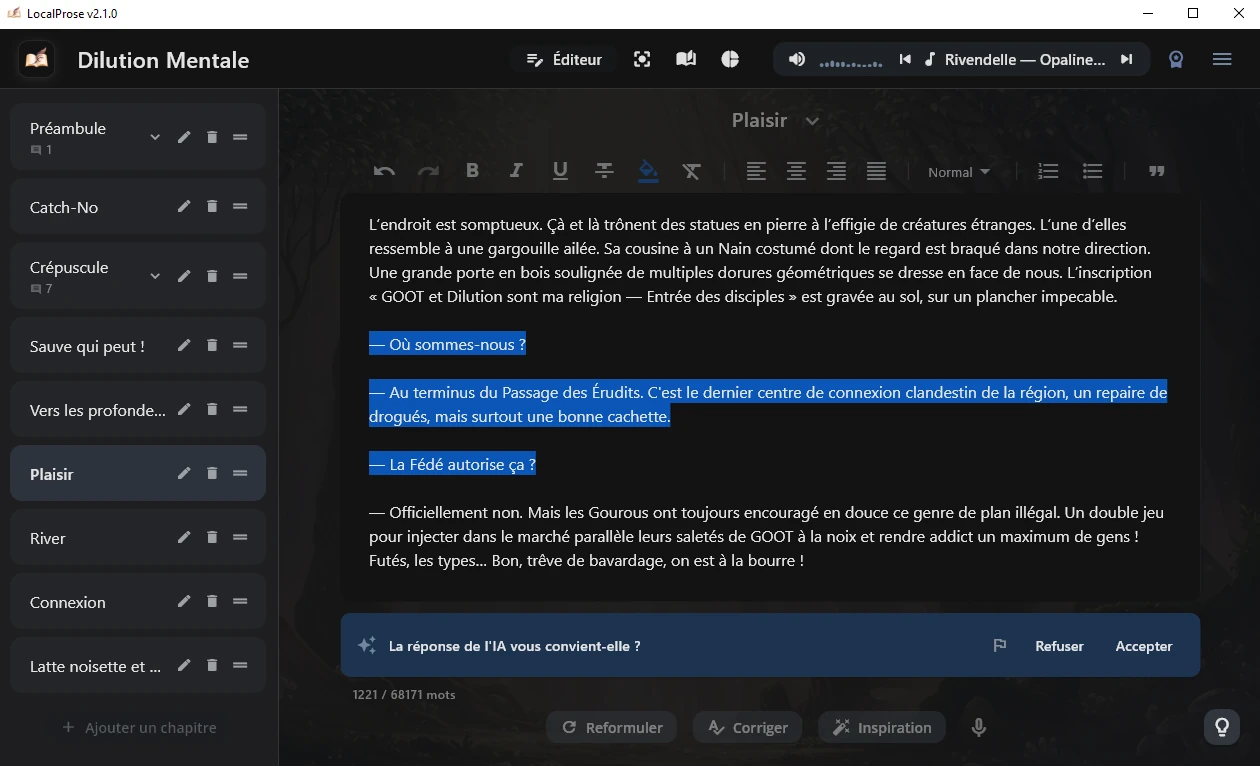
The literary world is currently divided over the use of what we call literary AI. On one side, we see the illusion of being able to "write an entire novel in a few clicks." On the other, the justified fear of standardized literature, generated by soulless algorithms, where the author's voice slowly disappears.
As an author, I know that writing is a deeply artisanal process. Every word, every comma, every silence results from a deliberate choice. If I hand those choices over to a machine, I become a mere proofreader of my own story.
The true value of an AI for writers does not lie in its ability to produce thousands of words a minute. Its real power is its ability to clear my doubts at the exact moment the text resists me. That is the essence of an AI co-author tool: a silent partner that remains in the shadows, stepping in only when I request its analytical expertise.
Writing a novel with AI: The 5 deadly traps of cloud generation
If you've ever tried using mainstream conversational models (ChatGPT, Claude, etc.) to write fiction, the disappointment was likely immediate. Using generic AI to craft literature raises several dangers that destroy a writer's uniqueness. Make no mistake: writing a novel with generic AI is the fastest way to kill your work before it even begins.
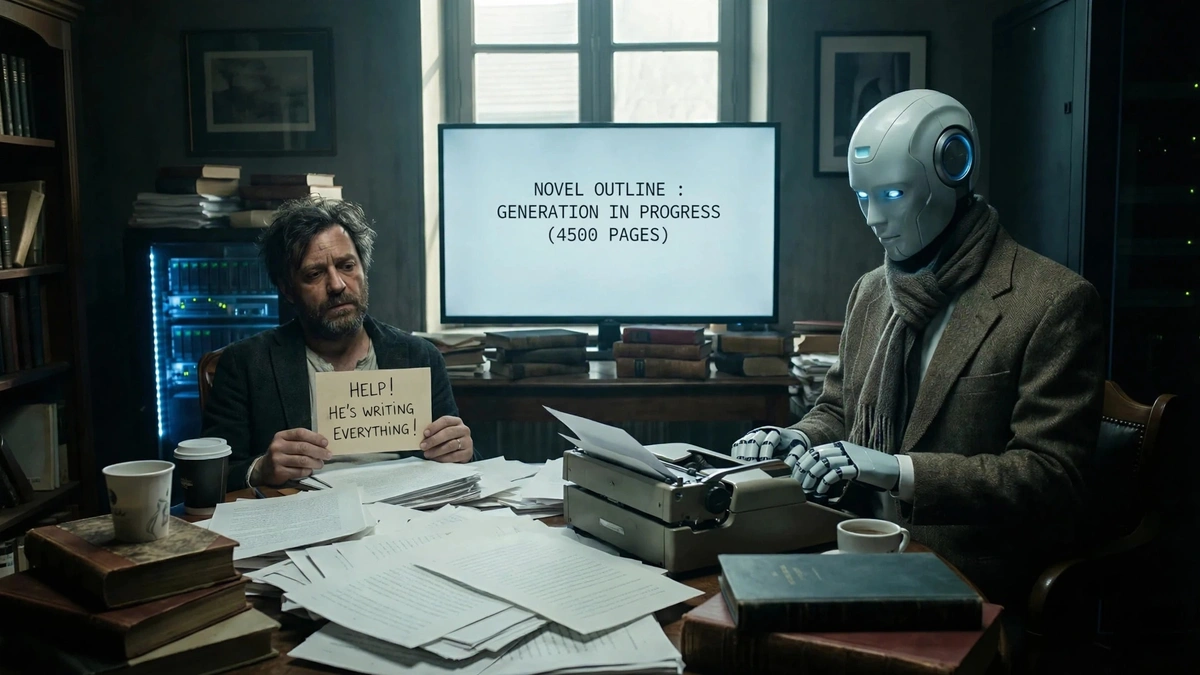
1. The "Wikipedia" style (Standardization)
Large Language Models (LLMs) operate on a probabilistic principle: they are constantly searching for the "most likely" next word. The result? AI defaults to "average" writing. It smooths out edges, erases linguistic quirks, refuses daring metaphors, and produces a highly uniform style. If I let the machine draft my paragraphs, I sacrifice my style.
2. "Moral censorship"
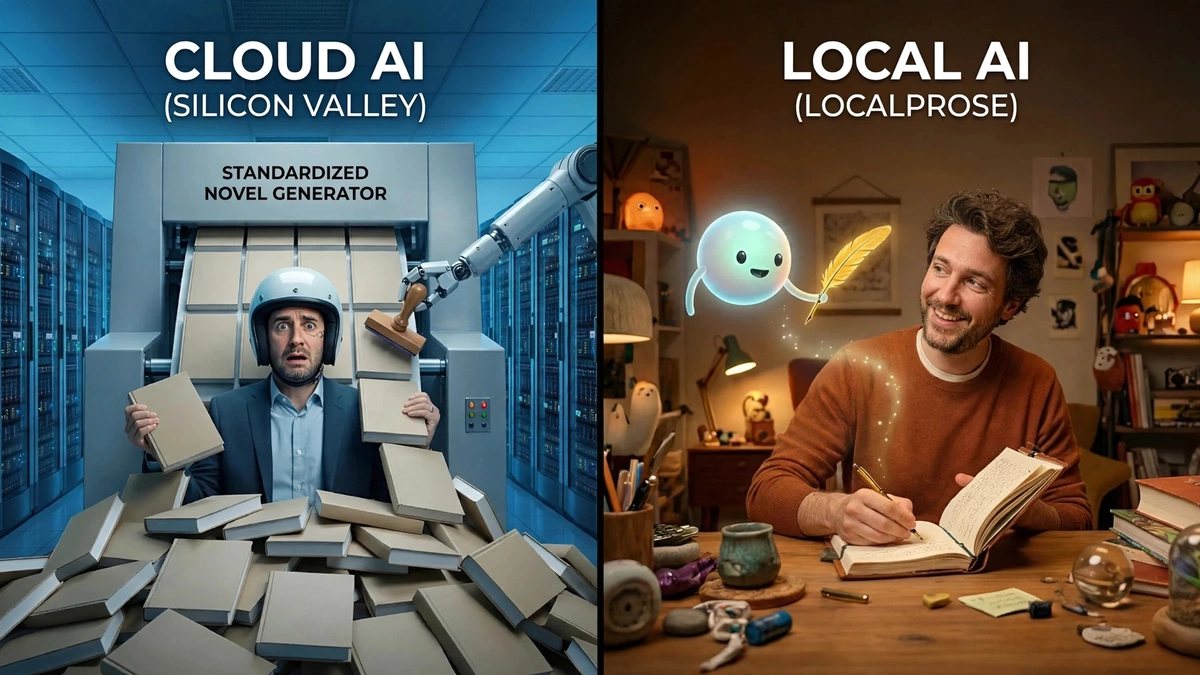
If I try to ask a cloud-based AI to write a gritty crime scene, a morally ambiguous conflict, or a brutal action sequence for my Dark Fantasy novel, I'll hit a wall. Commercial models are "aligned" by massive tech corporations to be polite and harmless. A true AI tool for authors shouldn't be subject to Silicon Valley censorship: it must follow me into the darkest corners of my plot.
3. Contextual amnesia
This is a frustrating technical limitation: conversational AIs forget quickly. After 20 messages, they forget my hero is left-handed or that the gun was loaded. A "Chat" interface is completely unsuited for an 80,000-word manuscript.
4. The privacy nightmare (Data theft)
Where do my ideas go when I paste them into a SaaS web app or an online writing platform? Even if the Terms of Service seem reassuring, I have no guarantee my texts aren't being analyzed, stored, or used to feed the publisher's databases to train future models. My world-building, my plot twists, and my style are digested by the machine. For a published or aspiring author, this privacy flaw is a risk I am unwilling to take.
5. Writing under quotas and dependency
The vast majority of online literary assistants run on a paid "token" system. Every analysis consumes part of your subscription. I end up writing under the pressure of a meter, hesitating to explore a wild idea for fear of "wasting" my credits. Even worse, if the AI solves all my narrative problems for me (the "magic button" syndrome), my own creative muscles begin to atrophy.
Local AI to the rescue
For a writer to collaborate peacefully with artificial intelligence, the solution was obvious from a technological standpoint albeit complex to build: the AI writer had to be extracted from the cloud. This is the core philosophy behind LocalProse.

A local AI means the algorithmic "brain" (the LLM) is physically downloaded to my computer. When I ask it to analyze a chapter, the "thinking" is done locally by my own processor (CPU) or graphics card (GPU).
Sovereignty and network independence
Internet is only required to validate my license and download models on the first launch. After that, I can turn off the Wi-Fi. My texts never leave my machine. Whether I'm on a train or isolated in a mountain cabin, my AI tool for writers keeps running at full capacity.
The right to fail at no extra cost
Since I'm using my own machine's electricity, there are no server fees to pay the publisher. No more credits, no more tokens. This lack of quotas gives me back the fundamental right to make mistakes: I can generate a hundred absurd ideas without spending an extra dime. Knowing my terrible first drafts aren't being read by external servers instantly lifts any self-censorship.
How to structure a novel with AI
Like many authors, I've wondered how to structure a novel with AI without feeling like I'm cheating. The answer lies in strict separation: drafting (my exclusive domain) vs. narrative engineering (where the machine excels). AI then takes its rightful place in my workflow as a powerful AI content optimization tool.
The AI novel structuring method
Forget basic prompts like "Write a 10-chapter thriller outline." The real AI novel structuring method in LocalProse begins with mapping my "Lore" (my story bible). I create profiles for my characters, locations, and items, which the software then maps into a relational graph.
From there, I don't ask the AI to write for me. Instead, I use it as a strict AI plot consistency tool through chapter auditing.
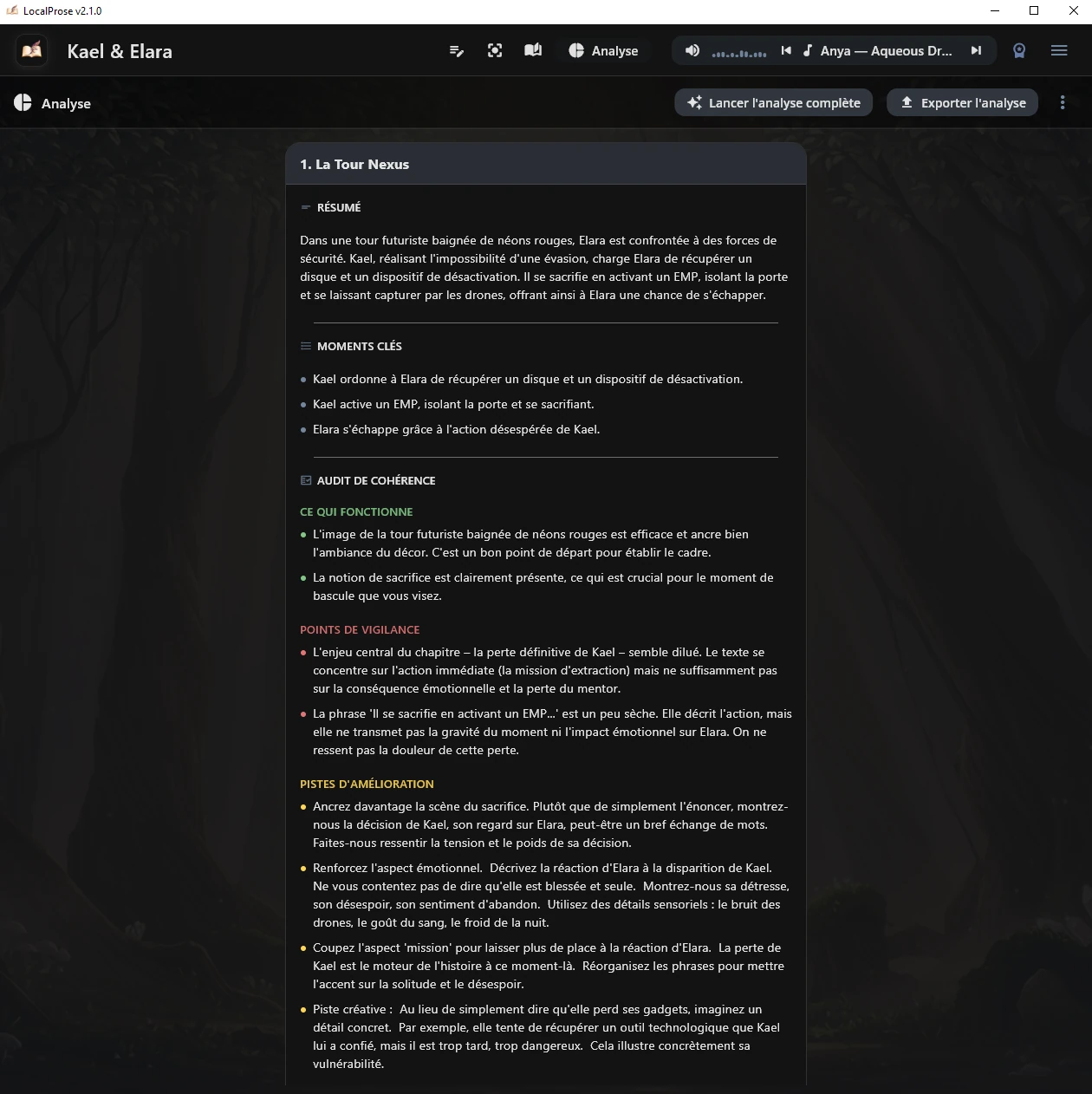
The Consistency Audit
After finishing a human-written scene, I run an Audit. The AI cross-references the raw text of my chapter with the intentions laid out in my story bible. It alerts me: "The tension drops in the middle of the dialogue," "Alice's reaction is inconsistent with her trauma profile," "The survival stakes aren't felt enough." It acts as an instant, highly specialized beta-reader working solely for me—leaving me completely free to fix (or ignore) its remarks.
Writer's block? Overcoming the blank page
We've all experienced that terrifying paralysis. You're stuck writing your novel. The cursor blinks in the middle of chapter 12. The further you get into a story, the heavier the mental load becomes (respecting the outline, psychological evolution, the overarching narrative arc). Writer's block isn't a lack of talent; it's cognitive overload in the face of too many choices.
How do you overcome writer's block with an AI? Here is the 3-step protocol I recommend, supported by the LocalProse ecosystem:
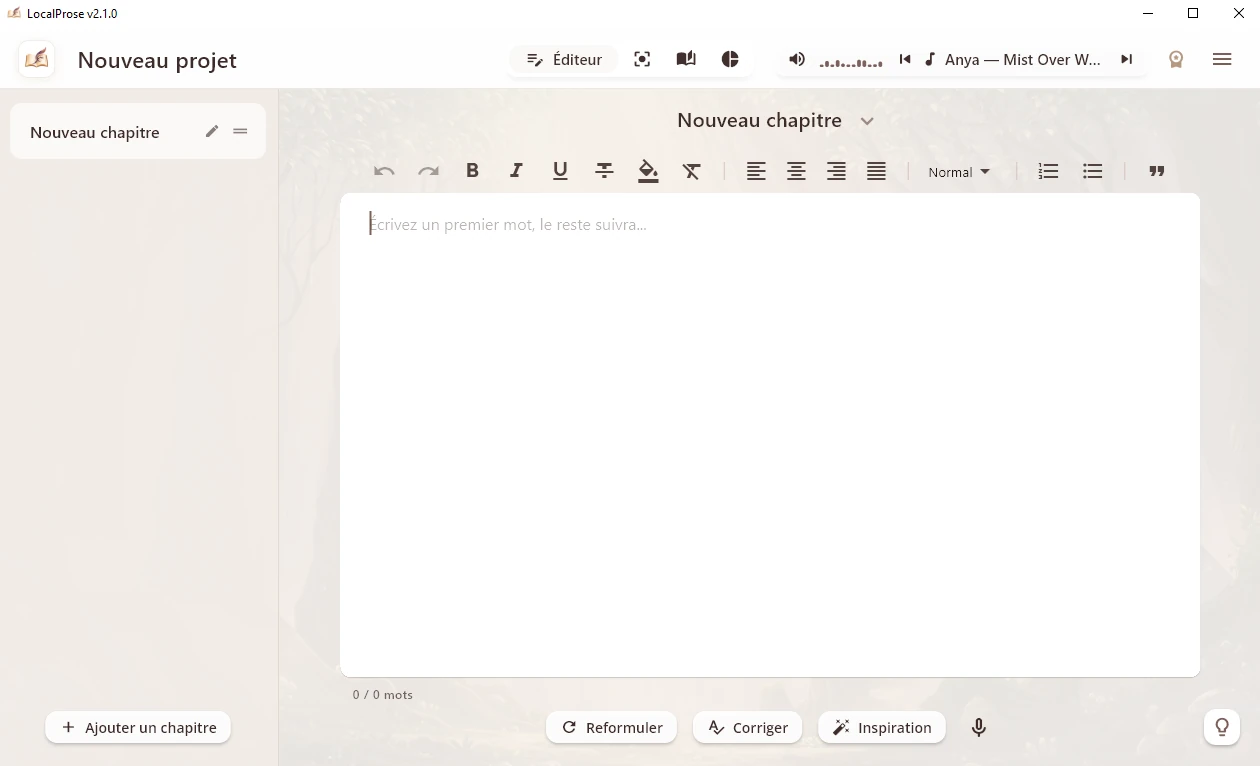
Step 1: sensory isolation
The first rule is to cut out the noise. Switch to Focus mode within the writing software to hide menus, stats, and toolbars. Shrink your visual world down to the single paragraph causing the problem.
Step 2: narrative friction
Stop looking for the perfect sentence. It's the demand for stylistic perfection that paralyses you. Write the action that *must* happen in bullet points or telegraphic style. Produce raw, even terrible material, just to force your brain to process something concrete instead of a void.
Step 3: guided brainstorming
This is where local AI steps in surgically. I highlight the paragraph that's dragging and trigger the "Inspiration" feature.
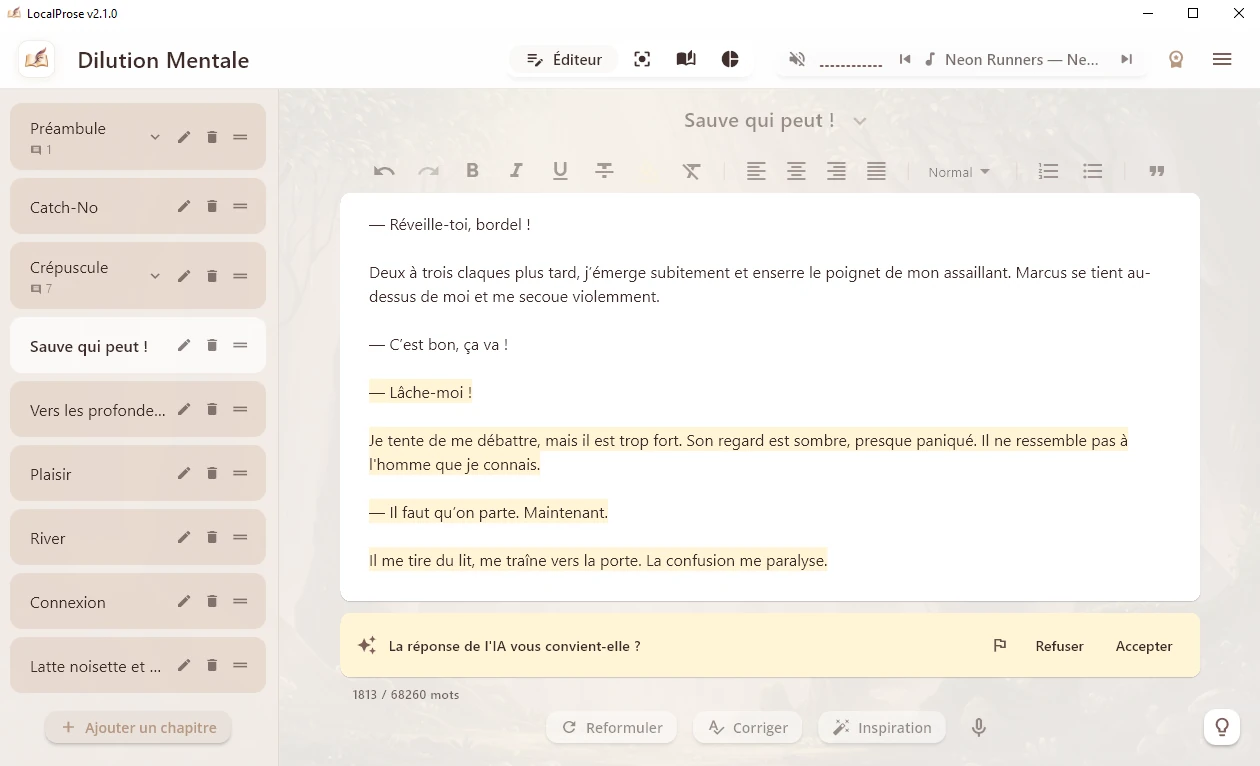
I then get several variant outcomes for my complicated scene or ambiguous dialogue. The AI doesn't write my novel, but it acts as a catalyst. By offering me as many choices as I want, it restores my decision-making ability. I reject path A, I hate B, but path C sparks a brilliant idea. I take back the reins, and the paralysis is gone.
Integrating LocalProse into my writing routine
For an AI tool to be sustainable, it must fade into the background. I don't see my writing software as a ghostwriter, but rather as my own private literary engineering firm.
My routine looks a bit like this:
- Morning: Drafting session. I write with the AI completely disabled. My voice, my authorial instinct.
- End of Chapter: I run the Consistency Audit. I read the feedback with a cool head.
- When Blocked: I use the local "Inspiration" feature to generate plot twists, or I virtually chat with my antagonist's AI clone (using the Character Interview mode).
AI technology is incredible, provided you tame it. By opting for a 100% local ecosystem free from predatory cloud servers, you harness algorithmic power without ever compromising your privacy or the soul of your art. AI must adapt to the writer, not the other way around.
Test local assistance on your next manuscript
Take back control of your universe. Discover the fundamental difference between a commercial text generator and a true, private writing studio hosted on your own machine.
Frequently Asked Questions
Which AI tool for writers should I choose?
The choice depends primarily on your privacy requirements. For total respect of your manuscripts and your style, a sovereign software like LocalProse is essential. It acts as a true AI tool for authors by running locally, allowing you to structure your story and unblock your scenes without ever sending your texts to third-party servers.
Will an AI for writers smooth out my style or replace me?
The risk of standardization is high if you ask a cloud AI to generate entire chapters. However, in an on-demand assistance approach, the AI doesn't write for you; it helps with brainstorming, suggests variations, and points out structural weaknesses. The author remains the sole judge of the final version.
How to structure a novel with AI without losing the thread?
A good AI novel structuring method doesn't mean delegating the outline's writing, but using AI as an auditing tool. Write your chapters, then use an AI plot consistency tool to check if your dramatic stakes work and if your timeline aligns with your character sheets.
How to overcome writer's block with AI?
If you are stuck writing a novel, don't look for perfect inspiration on the first try. Isolate the sentence or paragraph that's holding you up. Then ask your AI tool to generate several possible continuations (one focused on action, another on introspection). The goal is to create creative friction and regain a dynamic of choice.
Are my manuscripts safe with a local literary AI?
Yes, 100%. Unlike cloud tools where your texts are transmitted and can train other algorithms (creating a risk of plagiarism or leaks), a local AI novel tool downloads the language model directly to your computer. Your drafts, ideas, and scenes remain hermetically confined to your hard drive.