Methodology
Overcome the blank page syndrome and writer's block.
Writer's block is rarely linked to a lack of ideas but most often to an execution problem: a pivotal scene resisting or a mental load that is too heavy. Here is how to get your text moving again.
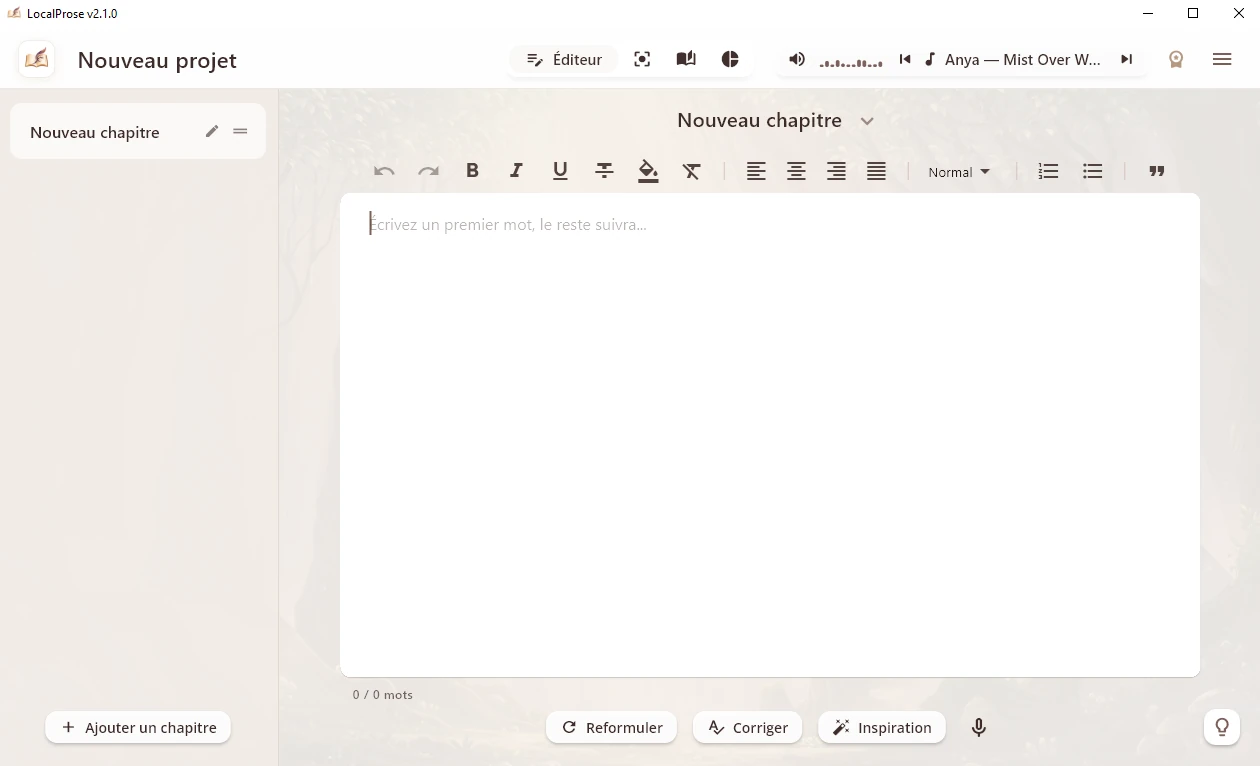
We have all experienced this moment. The cursor blinking endlessly on the screen. You type a sentence, you delete it. You open a new tab, you procrastinate, then you close the document with a sense of guilt. "I'll never get there! What a nightmare!"
We often associate the anxiety of the blank page with the beginning of a project. However, the paralysis frequently occurs in the middle of the manuscript. The further you get into a novel, the more the mental load increases. You have to maintain the consistency of your outline, oversee character evolution, and keep a steady pace.
The block isn't a talent failure but the moment your brain jams (or explodes) faced with an overflow of colliding variables (this even happens to experienced writers). The mind freezes before the anticipated workload. The author stops out of fear of breaking their story's structure. The anxiety is palpable and can even seem insurmountable, but fortunately, that is not the case.
Why traditional methods aren't enough
When trying to unblock yourself, you inevitably come across the same advice. While well-intentioned, it often proves ineffective against the real core of the problem.
The limits of usual remedies
Letting the text rest is useful for taking a step back but doesn't fix the narrative flaw. Upon your return, the scene that was blocking you will still demand to be handled.
Forcing the writing at all costs can break the initial procrastination. The risk is producing default, substance-less text that you will end up deleting entirely during the rewrite, feeding the frustration a little more.
The first step to regaining inspiration is to quiet the noise of the world. Don't hesitate to configure your own writing bubble in LocalProse's Focus Mode to isolate yourself visually and auditorily from any distraction.
How to unblock a novel scene through friction
Instead of waiting for perfect inspiration, the most reliable method is to work the material roughly. The problem regularly stems from too slow a start or a blurry intention.
Put style aside. Write down the stakes of the scene in three factual lines: who wants what, what opposes it, how it ends. If the scene produces no change for your characters, that's probably why it's blocked. It serves no function. You can sometimes even decide to delete it entirely (a little cleaning never hurts).
Next, force yourself to write two very brief alternative beginnings: one starting with immediate action, another with dry dialogue. Don't look for the right version; look for a dynamic. This approach often unlocks the writing and lets you feel the flow return in full force.
Rely on an active reader, not a generator
When the author is bogged down, the intention is often clear in their head, but the result on the screen seems bland. Dialogues lack impact. It's precisely at this moment that an external perspective becomes valuable to create "creative friction." The goal isn't to delegate the writing, but to explore avenues. This is exactly the approach you will find in LocalProse.
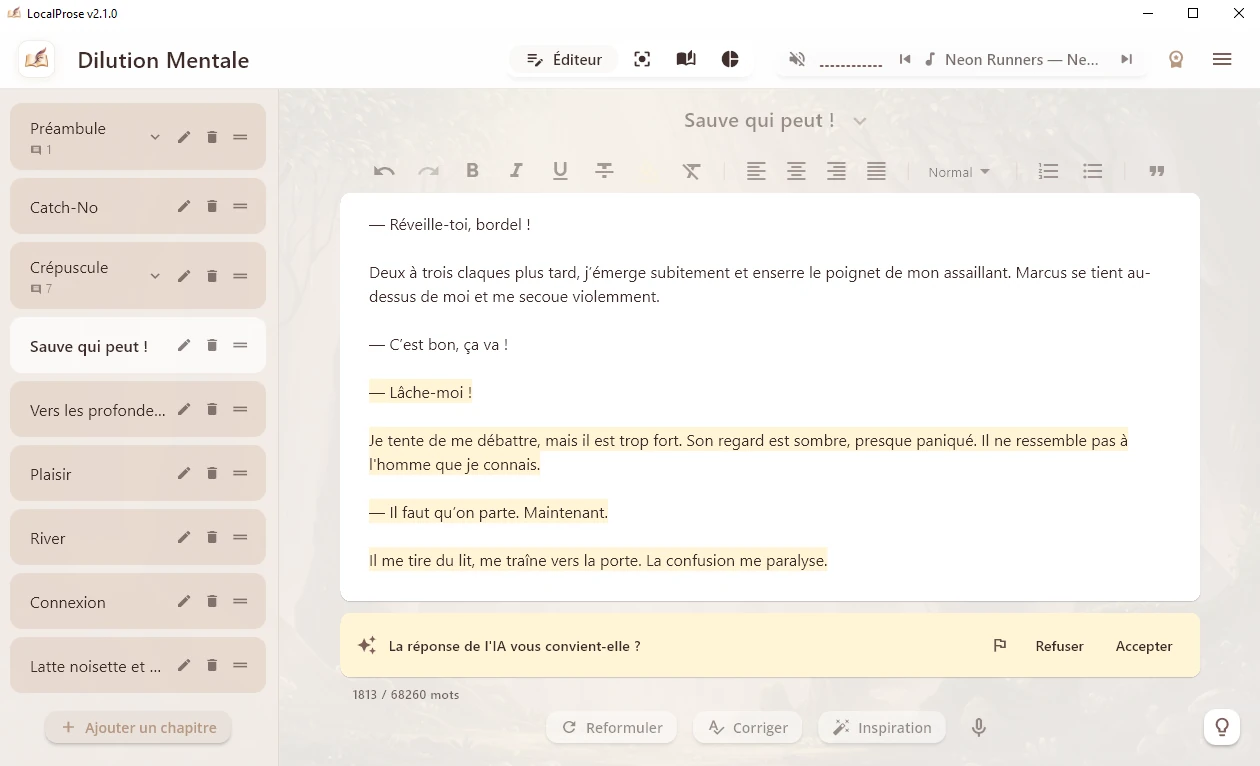
Select the sentence that rings false or the paragraph that's bogging down. Ask the assistant to rewrite, suggest a continuation (inspiration), or even analyze a whole chapter (software's Analysis view) to get rewriting advice. You take back control immediately after and decide the final version, having engaged with the recommendations, but you are no longer alone facing the void.
Protect your writing: the importance of local processing
The passages we stumble over are very often the most intimate, the most vulnerable. They are the foundations of our story.
Entrusting your hesitations, drafts, and intention notes to an online word processor or software hosted on the web (Cloud) poses an obvious privacy problem for a professional or amateur author. Using analysis tools to restart your writing should never come at the cost of sending your work to a third-party company's servers.
It is for this fundamental reason that the LocalProse workshop embeds its own AI. While an internet connection is required at launch to authenticate your access, it never intervenes in the processing of your texts. Any search for inspiration, structural analysis, or rewriting runs strictly on your machine's processor. Once logged in, you can write on the train or suffer a network outage: the workshop and its AI continue to function behind closed doors.
☁️ Standard cloud tools
Require a constant and flawless connection. Your blocks and attempts are sent to external servers. Billing is often tied to a "credit" system that restricts experimentation.
🔒 The LocalProse approach
The internet serves as the entry key; your machine does the rest. The local AI utilizes your processor, RAM, and graphics card. You test a hundred phrasing options without spending a dime more, and your data never leaves your hard drive.
The blank page syndrome is an intrinsic part of the writer's job. The goal isn't to eradicate doubt (good luck if you think you can achieve that!) but to have the right reflexes and appropriate tools to find your rhythm without exhausting yourself, scene after scene.
Take back control of your story
Join the authors using their computer's power to conquer writer's block and structure solid stories.
Frequently asked questions
Why do I have writer's block when I have a detailed outline?
Having an outline doesn't protect you from the anxiety of the blank page. The block very often occurs during execution, when you have to choose the right tone, the pace of the narration, or the right entry point for your scene. It's the accumulation of these micro-decisions and the fear of making the wrong choice that paralyzes the drafting, not a true lack of ideas.
How do you unblock a novel scene without starting from scratch?
Don't look for perfect inspiration; look for creative friction. Isolate the specific sentence or paragraph that bogs down the scene. Then, force yourself to write several very quick variations: one focused purely on action, one on dialogue, one on introspection... The goal is to regain a dynamic of choice to get the story moving again, rather than suffering the emptiness of the page.
What is the risk of using an online AI to overcome a block?
Generative AIs hosted in the cloud are designed to produce consensual text. If you ask them to write the continuation of your chapter, they risk smoothing out your style and proposing simplistic resolutions. Moreover, your texts become training data. A true novelist's assistant should stick to auditing the structure or suggesting avenues so that you remain the sole master of the writing.
Does LocalProse require an internet connection to work?
Yes, a connection is required at launch to authenticate your account and validate your license. However, it is never used to process your text. Drafting, saving your manuscript, and artificial intelligence analysis run entirely locally on your machine. If your network drops mid-session (on a train, for example), you can continue writing and using the AI without interruption.