Ethics & Creation
Writing a novel with AI: the 5 traps that kill your creativity (and how to avoid them).
Artificial intelligence is a powerful tool, but used poorly, it can turn your work into standardized, censored, and soulless mush. Here is how to tell the difference between "generation" and "assistance."
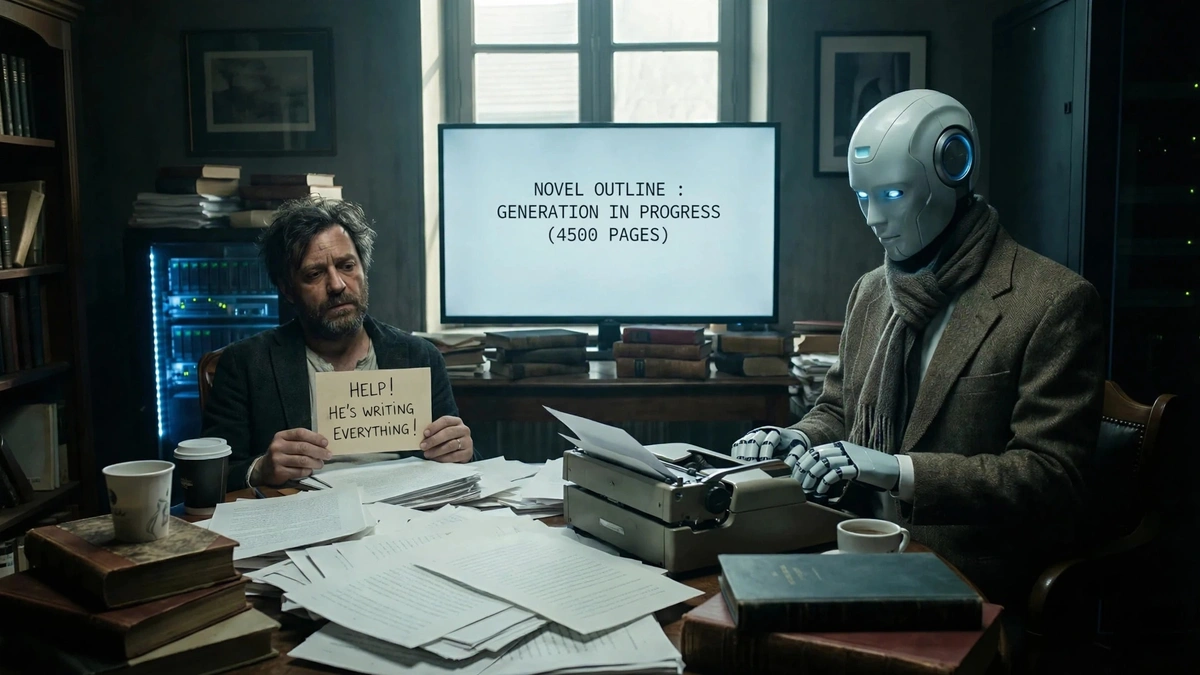
Let's be honest. Since the arrival of ChatGPT, Claude, and others, the temptation is strong. "Go ahead, dear AI bot, write chapter 3 for me." And poof! The result pops out. It's magic, it's fast. But have you read the result? Truly read it?
It's bland. Full of clichés. And most importantly, it isn't YOU.
As the creator of LocalProse, I take the stance of developing an AI tool that doesn't replace the author, but acts in their service. I have compiled a list of the 5 dangers that I believe lie in wait for writers in the era of generative AI, and you'll see how my local approach attempts to solve them.
Trap #1: "moral censorship"
Try asking a cloud AI (like Claude or ChatGPT) to write a realistic crime scene for your thriller, or a complex interaction for your Dark Fantasy.
The danger: you are going to hit a wall. Commercial models are "aligned" to be polite, harmless, and consensual. As soon as you touch on adult, violent, or morally ambiguous themes — which are the very spice of dramatic literature — you logically get a flat refusal: "I cannot generate violent/explicit content blah blah blah...".
If you copy the result exactly as is, your novel becomes sanitized. Your villains become harmless caricatures. Yet, literature isn't there to be "safe"; it is there to explore human complexity, including its dark side.
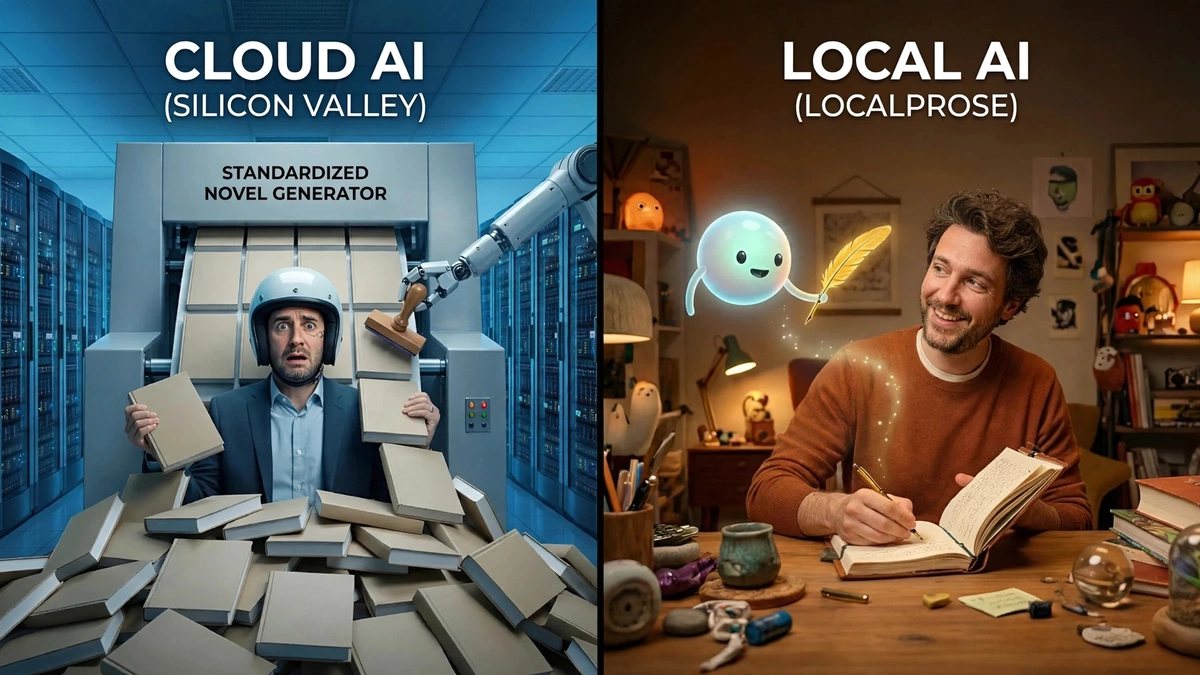
🛡️ The LocalProse solution
As I showed in my case study on creating my character Valerius, local AI has no moral filter imposed by a third-party company. It is your machine, your rules. If your story is dark, the AI will follow you into the darkness. Personally, this is what I expect from an intelligent assistant: that it remains faithful to my raw vision.
Trap #2: contextual amnesia
This is a current technical limitation: conversational AIs forget quickly. After 20 exchanges in a classic chat, they no longer know that your hero is left-handed, that the city burned down in chapter 1, or that the murder weapon was a candlestick.
The danger: the "Chat" interface (infinite discussion) is not suited for long-form writing. Ultimately, you spend more time reminding the AI of the context than actually writing ("Remember, John is angry at Alice..."). Hallucinations and inconsistencies pile up, turning your assistant into a burden that constantly needs correcting.
This is why I developed the relational graph and visual world-building. Even though local AI also has a limited "memory" (context window) that depends heavily on your machine's capabilities, LocalProse allows you to structure your data outside the conversation flow. Your character, location, and object sheets (entities) remain anchored and accessible at any time alongside the word processing section. This way, you never lose the thread, where a cloud conversational AI will always eventually lose its way.
Trap #3: privacy (the author's nightmare)
When you copy-paste your manuscript into a web window of an online application, do you know where your ideas go? Often, the terms of service (ToS) are vague: your texts feed external databases and are used to train future models.
The danger: your human style, your plot twists, and your original ideas are digested by the machine to indirectly serve other users. For an author, whose core business is the originality of their ideas, this is a major intellectual property risk. Not to mention the psychological aspect: you never write as freely as when you know the door is locked.
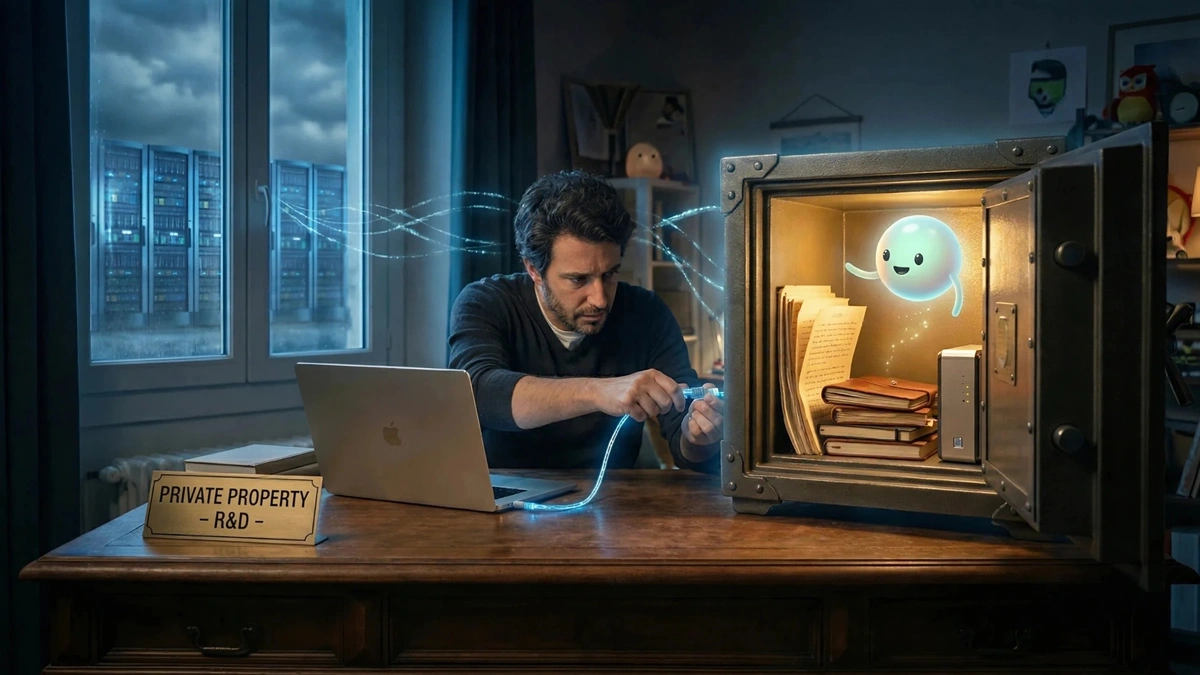
With LocalProse's Local AI, nothing leaves your PC. Aside from downloading the AI models locally on the first launch (or when you decide to change models in the settings), you can then disconnect from the internet: LocalProse continues to function without hindrance. This is total digital sovereignty.
Trap #4: the "Wikipedia" style
Large Language Models (LLMs) operate on a probabilistic principle: they always look for the "most likely" word to follow the previous one. The result? By default, AI writes in an "average" way. It smooths out rough edges, erases linguistic quirks, and produces a uniform style, often compared to a Wikipedia page or a corporate report.
The danger: if you let the AI draft your paragraphs autonomously, you lose your "voice." What makes a great author is precisely their unexpected choices, their changes in rhythm, their daring metaphors. AI, by design, seeks to reduce this creative entropy.
Do not use AI to draft for you but to brainstorm and structure. Use it to challenge your outlines, to find synonyms, to check the logic of a scene, but not to lay down the final words. Your authorial voice is irreplaceable. The AI is there to give you the bricks, not to build the house for you.
Trap #5: dependency (the magic button)
By constantly generating, we forget how to imagine. Writing is a muscle that atrophies if you don't use it. There is an addictive pleasure in seeing text appear with a click, but it is an illusion of productivity.
The danger: if the AI solves all your narrative blocks for you, you will never develop your problem-solving skills (the famous writer's "Problem Solving"). The day the tool is no longer there, or it doesn't understand your vision, you are paralyzed in front of the blank page.
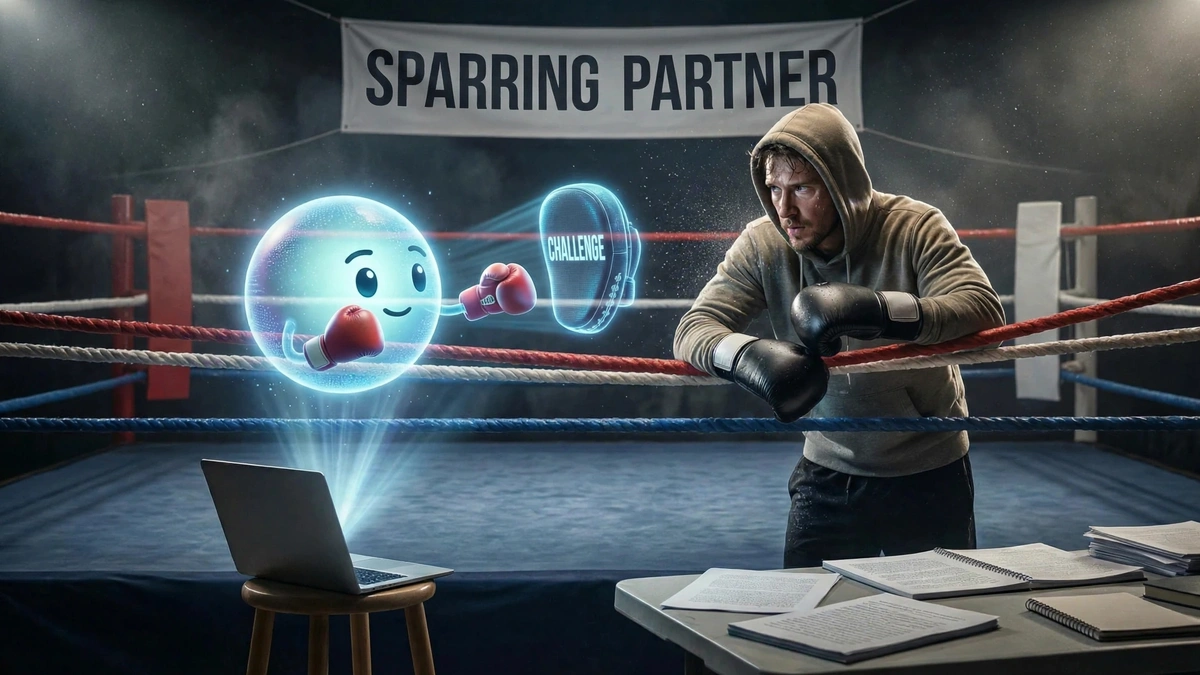
Personally, I consider LocalProse as a sparring partner. It is there to bounce ideas back at you, to unblock you when you're stuck on a description, to offer you 10 wacky ideas of which you'll only keep one. You remain the conductor; the AI is just one instrument among others and is not there to replace the steering of your creative juices.
Take back power over your writing
Try the tool I designed for demanding authors, not for generating spam.
Private. Uncensored. Local.